Wednesday, May 3, 2017
Reading Response: 13th
As you watch the documentary, I'd like for you to think about how this form of storytelling compares with other texts we've read. Do you find the film more or less compelling than poetry ("Cells and Windows," for instance) or memoir (ex: Between the World and Me) or fiction (ex: Homegoing)? Why do you think that is? How does documentary function differently as a genre than other forms of representation? Make sure to refer to particular strategies or elements from the film to make your points. This response is due no later than May 9 (but the end of the day is fine).

Tuesday, May 2, 2017
Mass Incarceration: The Presidents
Nixon Administration 1971
Nixon’s trusted advisor spoke out and said that the war on drugs was a war on black people. The images that the media and Nixon had used painted a picture of urban and black communities being the main place where drug issues took place. This is one traceable starting point of black communities being blamed for drug crimes. Nixon’s plan lead to a racial profile being created of those that used recreational drugs.
It also lead to an increase of incarceration of nonviolent criminals, seeing as how most non violent criminals are convicted of drug crimes.
Reagan Administration 1984
Reagan passed the comprehensive criminal reform act, and the bail reform act. The bail reform act allowed judges to take civilian safety into consideration when granting or denying bail
the Correction Corporation of America was awarded a contract to take over a correctional facility and it was the first prison in the United States to be private owned. (This created a big problem because of private prisons being opened made it easier to care for low cost inmates, and now people can make money off of those in jail)
Bush Administration 1989
Bush gave an oval office speech about the war on drugs. He said he pledged one billion dollars to build more prisons and facilities, stating, that that is what we need.
From this mandatory minimum sentences were enacted, and racial disparities were worsened.
Clinton Administration 1994
Bill Clinton passed the 3 strikes policy which mandates a life sentence for those who commit violent felonies after 2 prior convictions. This amplified mass incarceration issues significantly.
It became impossible for you to be taken seriously for candidacy and be soft on crime. Around 1987 the murder was increasing by 5% every year and Bill’s reaction was to squash the violent crime by keeping repeat offenders locked up permanently
Now this graph here shows the number of incarcerated citizens increasing exponentially from 1994 to around 1999 and then it plateaus and slowly continues to creep up. You can also see that there are more 3 time strikers in jail than 2nd time, and this policy drastically increases those in prison.
Bush Administration 2004
Prison Rape elimination act of 2003 focused on ending sexual assault in prisons, this is helpful toward ending mass incarceration because sexual assault that happens to prisoners makes them far more likely to commit violent crimes and end up back in prison. The sexual assault of people that have committed nonviolent crimes is a big issue.
300 million dollar grant by George Bush (Prisoner Reentry Initiative) will give people a second chance by providing education and job training, which will help decrease the likelihood of people committing more crimes and going back to prison.
Bush believed that people need to know their rights, but that we shouldn’t stop confessions to read people's rights. However, many wouldn't admit to something had they been read their rights.
Obama 2015
Obama spoke at the annual meeting of the NAACP to talk about the problems with mass incarceration also to say: “you forgot women” He spoke about how mass incarceration is not just an issue in the african american community but also a female issue, because it happens to women too.
He also mentioned that we spend $80 billion a year on incarceration, and quote: “could provide free pre-K for every 3 and 4 year old, or double the salary of every high school teacher.”
He ended his speech by calling for an end to mass incarceration, and to build communities that offer second chances.
He was the first president to visit a jail and talk with corrections officers about issues they face.
As a result of this visit 6,000 inmates were going to be released federally. Of that 6,000 about 1,800 were illegal immigrants that were turned over to ICE and a deportation process was beginning (all 1,800 had committed violent felonies on top of being undocumented, and as part of an effort of immigration reform, Obama ordered they be turned over to ICE). Many of the others went to halfway housing where they can receive the rehabilitation and treatment that they need to be reintegrated to society.
The Obama Administration also had some unconventional ideas to reduce mass incarceration. The idea behind raising minimum wage (which I did not know) was to reduce illegal activity that has been found in low income areas to make ends meet (a 3-5% decrease in crime and incarceration). Another idea was to add around $10 billion to expand police forces and cut back on crime by around 16%.
Works Cited
Bond, Walter. "Nixon's 'War on Drugs' Was Government-sanctioned Terror on Black people."
TheGrio. The Grio, 29 Mar. 2016. Web. 30 Mar. 2017.
Diamond, Jeremy. "Bill Clinton Concedes Role in Mass Incarceration." CNN. Cable News
Network, 07 May 2015. Web. 22 Mar. 2017.
Ehrenfreund, Max. "Obama’s advisers just revealed an unconventional solution to mass
incarceration." The Washington Post. WP Company, 25 Apr. 2016. Web. 01 May
2017.
"George W. Bush on Crime." George W. Bush on Crime. N.p., n.d. Web. 01 Apr. 2017.
<http://www.ontheissues.org/Celeb/George_W__Bush_Crime.htm>.
Guillen, Magdalena. "Mass release of US prisoners spells deportation for hundreds."
AOL.com. AOL, 14 July 2016. Web. 01 May 2017.
"Go to Bing homepage." Nixons War on Drugs - Bing images. N.p., n.d. Web. 25 Apr.
2017.
“Go to Bing homepage." Crime Rates after 3 Strikes Policy - Bing images. N.p., n.d. Web. 25 Apr. 2017.
Lopez, German. "Obama: $80 Billion Spent on Incarceration Could Eliminate Tuition at Public
Universities." Vox. Vox, 14 July 2015. Web. 30 Mar. 2017.
Moore, Antonio. "President Bill Clinton Gets It Wrong On Mass Incarceration." The Huffington
Post. TheHuffingtonPost.com, 07 Apr. 2016. Web. 22 Mar. 2017.
Neyfakh, Leon. "Obama Wants to End Mass Incarceration. But Does He Have the Power to
Make a Difference?" Slate Magazine. N.p., 15 July 2015. Web. 14 Mar. 2017.
Newman, Tony, and Bill Piper. "Friday: 25th Anniversary of President George H.W. Bush's
Infamous Oval Office Speech Escalating "War on Drugs"." Drug Policy Alliance. DrugMass Incarceration
Mass incarceration is an era that began in the united states around the year of 1971. The war on drugs was an influential in regards to the prison population rate between 1970 and 2015. The U.S.currently holds the largest prison population in the world totaling a number of more than 2.3 million by the year of 2015. according to the FBI statistics, in 1970 there were over 357,000 prisoners in federal and state prisons combined and by 2015 the number of state and federal prisoners in the U.S. was over 2.3 million.

“Incarceration has increased more than 500% in the last 40 years..Half of the people in federal prisons are serving time for a drug offense” (Sentencing project 2017)
Crack Cocaine was developed in the 1970's and began to spread quickly by the 1980's. Drug sentencing became more harsh and roadside drug tests were invented to help reduce drug driving, The tests worked by binding the antibody to the drug of interest which then produced a positive result. The issue is that the antibody was able to bind to other things that were not cocaine, producing a positive result even if the person being tested had not done cocaine. Crack cocaine penalties were extremely long and harsh compared to other drugs and because of this faulty drug testing there were many innocent people being locked up for long periods of time.
A case study from sentencing project talks about Kemba Smith's story of incarceration. While seven months pregnant she was sentenced to 24.5 years in prison for conspiracy to participate in her boyfriend's drug activities, a non-violent, first-time offense. In her story she claims to have known that her boyfriend at the time was selling drugs and they were living off of the profits. Unfortunately, it did not matter that this was a one-time, non-nonviolent offense. it was an offense in the eyes of the court and she was convicted due to affiliations with her boyfriend's drug selling business. Unfortunately there are thousands more like Kemba and many that have faced life in prison without the chance of parole due to this harsh sentencing. The biggest issue with the treatment of drug cases is the perspective from which it is looked at and the fact that they are designed to put away hardened criminals. Many people are uninformed when it comes to drugs and their effect on society and the penalties are much harsher than needed for those who do not have malicious intent.
The DPA states that "Despite recent federal reforms of crack sentencing laws much higher penalties still exist for possession and sale of crack, despite the fact that, pharmacologically, it is the same drug as cocaine. Possession of 28 grams of crack cocaine yields a five-year mandatory minimum sentence for a first offense; it takes 500 grams of powder cocaine to prompt the same sentence."
The laws revolving around drug sentencing provide a deeper explanation as to why such a large population of people are incarcerated due to drug related offenses, Through the development of more accurate drug testing, more flexible laws, and further education on the effect of drugs we can help end the era of mass incarceration
Works Cited
"Survey of Inmates in State and Federal Correctional Facilities, 1997 (ICPSR 2598)." Survey of Inmates in State and Federal Correctional Facilities, 1997. N.p., n.d. Web. 02 May 2017.
"Unreliable drug test leads to wrongful convictions." Innocence Project. N.p., 11 July 2016. Web. 02 May 2017.
"Watch Truth About Drugs Documentary Video & Learn About Substance Addiction. Get The Facts About Painkillers, Marijuana, Cocaine, Meth & Other Illegal Drugs." Foundation for a Drug-Free World. N.p., n.d. Web. 02 May 2017.
Mauer, December 21 2016| Marc, December 20, 2016| Angela Maria Kelley & Cristina Moreno, December 20, 2016| Angela Glover Blackwell, December 19 2016| Ron Pollack, and December 19, 2016| Senator Jeff Merkley. "The Obama Legacy: Chipping Away at Mass Incarceration." Talk Poverty. N.p., 21 Dec. 2016. Web. 02 May 2017.
Thursday, April 27, 2017
4/27 Class Notes Summary:
Class started off with Dr. West sharing her opinions on Black lives matter, and how we as Christians should at least be willing to listen to those crying out for equality and true freedom. She highlighted what Bethany mentioned a few classes back that “history asks us to know something, but literature allows us to feel something”.
We then looked at the Universal Declaration of Human Rights and discussed about the importance of having equal access to justice. Then, touching on the poem “From the Mothers of Murdered Sons”, we saw the importance of the meanings that blood and birth brings. The symbolism that blood brings both life and death, and the reference of woman with Trinity. Even through anger and rage, the poet still turns to God. Which brings about hope knowing that the presence of God is still there.
As we dive into the poem “Left”, we came upon two important ideas. We mentioned the misspelling such as the missing “e” in “Please”, which reflects the importance of education and its privilege. Finney then connects this to those left behind, and being left out of such privilege. Not only that, Courtney brought out the importance of the repetition “Eenee Menee Mainee Mo”. This brought up a great discussion on how the poet uses the refrain and broken epigraph to thread the ironic fact that us (as readers) are watching a game. The entire poem threads along cultural moments and a sense of combat which makes us question who the hero and victim in the poem is, and ties along powerful allusions to current events.
Jay also presented on the importance of black power, and how Malcom X’s ideology influenced the perspectives of many through his legacy and his autobiography.
Analyzing “To Malcom X on His Second Coming”, we discussed how the poem started off with Malcom resurrecting, and landscaping through his own prophecy. Yet what he sees is not a positive image, and was not what he had envisioned for the black people. Rather, he sees signs of materialistic wealth, and griefs upon what he sees. The plantation porch addressing to Liza also signifies the different type of enslavement and division, reminding us that slavery is not dead. The poem ended with a powerful message to the reader. That we should anoint the young and to continue to hold on to the vision of what it means to be powerful as a black.
As we read the next poem, “Blues for Malcom X”, the figures that are put on the stamps signifies the attempt of trying to silence the voice of each of the figures. But the poet was able to show that the voice of Malcolm will not and cannot be silenced. We ended class with a powerful video on Finney’s Acceptance Speech.
Personal Notes:


Wednesday, April 26, 2017
Malcolm X and Black Power

In 1938, Malcolm X was kicked out of school and sent to a juvenile detention home in Mason, Michigan. He attended Mason High School wherein He excelled academically and was well liked by his classmates. This reality would soon change for Malcolm in 1939, when his English teacher asked him what he wanted to be when he grew up to which he replied with a lawyer. His teacher responded, "One of life's first needs is for us to be realistic. . .you need to think of something you can be. . .why don't you plan on carpentry?" Malcolm X dropped out of school the following year, at the age of 15.
Malcolm then moved to Boston and found himself caught up in a lifestyle of drug selling and other crimes. In 1946, he and a friend were arrested and convicted on burglary charges causing Malcolm to be sentenced for 10 years and ultimately serving out 7 of those years imprisoned.
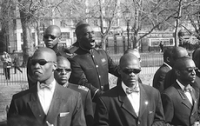 During this period of imprisonment, Malcolm’s brother Reginald would visit and discuss his recent conversion to the Muslim religion. Reginald himself belonged to the religious organization the Nation of Islam (NOI). Consequently he introduced Malcolm to the organization and Malcolm then began to study the teachings of NOI leader Elijah Muhammad. In 1952 Malcolm paroled and was also a devoted follower to the NOI with the new surname “X” (He considered “Little” to be a slave name and chose the “X” to signify his lost tribal name.) Malcolm was later appointed as a minister and national spokesman for the Nation of Islam. Malcolm x was also charged with the task of establishing new mosques in cities such as Detroit, Michigan, and Harlem. Through television, radio and newspaper columns, Malcolm X would communicate the NOI’s message across the United States. Malcolm X was articulate, passionate and inspirational to many. He exhorted black people to cast off racism "by any means necessary," one of which being violence.
His militant proposals won him large numbers of followers as well as many fierce critics. Ultimately, as a result of his efforts, Malcolm was largely credited with increasing membership in the NOI from around 500 in 1952 to around 40,000 in 1960.
At the height of the civil rights movement in 1963, Malcolm’s faith was greatly damaged. He learned that his mentor and leader, Elijah Muhammad, was secretly having relations with as many as six women within the Nation of Islam organization, some of these relationships resulted in children. This revelation severed Malcolm’s relations with the NOI that would not be fixed again. As a result of a statement Malcolm made on the assassination of President JFK, Elijah Muhammad “silenced” Malcolm for 90 days. Malcolm, however, suspected he was silenced for another reason.
Malcolm X resigned from the NOI and took a trip to Mecca. There he discovered that orthodox Muslims preach equality of the races. Upon his return to the states he continued his engagement with the mainstream of the Civil Rights Movement, however, this time he was now open to voluntary racial integration as a long-term goal. This “new” Malcolm X would be short lived because on February 21, 1965 he was assassinated by members of the NOI at a rally in which he was speaking. three gunmen rushed Malcolm onstage and shot him 15 times at close range, consequently Malcolm died. Interestingly, Malcolm X had predicted that, though he had but little time, he would be more important in death than in life. Foreshadowing of his martyrdom is found in The Autobiography of Malcolm X.
Malcolm X's ideals became the foundation for the Black Power movement itself. This movement, which gained prominence after Malcolm's death, began in the late 1960s. Its ultimate goal was to achieve “self-determination” for people of African descent. "Black Power" emphasized racial pride and the creation of black political and cultural institutions in order to promote black collective interests and values.
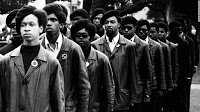
The term was coined by Stokely Carmichael and Willie Ricks. Together they organized the Student Nonviolent Coordinating Committee (SNCC). This organization was committed to nonviolence, however, the "Black Power" movement as a whole transitioned into more violent actions. One of the more violent and infamous groups were The Black Panther Party. This
Works Cited
"Biography." Malcolm X. N.p., 10 Feb. 2015. Web. 25 Apr. 2017.
http://malcolmx.com/biography/
History.com Staff. "Malcolm X." History.com. A&E Television Networks, 2009. Web. 25 Apr. 2017.
http://www.history.com/topics/black-history/malcolm-x
Fairclouth, Adam. "BBC - History - Better Day Coming: Civil Rights in America in the 20th Century." BBC News. BBC, 2003. Web. 25 Apr. 2017.
http://www.bbc.co.uk/history/recent/civil_rights_america_04.shtml
Muir, Hugh. "Malcolm X: the man behind the myth." The Guardian. Guardian News and Media, 07 Apr. 2011. Web. 25 Apr. 2017.
https://www.theguardian.com/world/2011/apr/07/malcolm-x-man-behind-myth
Class Notes 4/25
Today we are talking about the present and thinking about our knowledge of our past shape our lives today. We also talked about Black Lives Matter and Malcolm X and his life. We started out by thinking about human rights in our contemporary context. We did a reading accountability about Black Lives Matter, Hurricane Katrina and the way it affected our school, home and church lives. We also wrote about the essays that we read for today; “Black and Blue” and “The condition of Black Life is One of Mourning” and how they tell us about the state of racism in our contemporary context. The Black Lives Matter movement has been made easier to see with the invention of social media and that allowing people to see the way that Blacks were treated throughout our American History and even in the current society. It is offensive to say all lives matter instead of black lives matter because it diminishes the way that people feel about the suffering of the black community.
Dr. West then started talking about the 16th Street Baptist Church shooting and the Mother Emanuel. We learned that the Black church has been a target for white supremacist groups because the churches are the only thing that the Black community could own and control and the white supremacist groups tried to take that away. We then talked about the devastating Hurricane Katrina and how it affected the people of New Orleans. We then saw the statistics about the Hurricane and out of the ones who could not evacuate, 93% were black. The statistics also showed that the most devastated part was the ones in poverty. As a class, we then moved to a class discussion about “Of Poetry and Protest”, and the way that it talked about the murders and the way it had the list of deaths. Jordan made a comment about how important the movements are and that they have to work together to make the movement work. The essays set the stage of continuity of history with racism.
The two essays that we read for today, gave us a good look into the different treatment that whites get from blacks. We look at “The Condition of Black Life is One of Mourning” and can see that the continuity throughout our history and present of racism. The following quote caught the eye of us today in the discussion and shows us the way that the Black community lived through their days knowing that death is common amongst African Americans. “Dead blacks are a part of a normal life here” she would say it with very little emotion like they were very common amongst the African American lifestyle in the United States. The ability to tell your story and being heard is a huge stepping stone for moving forward with our history and present. All during our history as Americans, there have been differences between different types of people. Some were affected more so than others, for instance, the black community has been affected by the memory of slavery amongst other Americans. “Walking is as simple as putting one foot in front of the other, however walking is not so simple if you’re black” - (Black and Blue). This quote shows that not only is hard enough to live in the present, but when you have all of the stereotypes and memories of the past to live with, it makes it even harder. If you’re a part of a black community in America then it is tough for you and that’s why this quote was a big part of our class discussion for the day. Another quote that we talked about for the day was, “Do not run you have no rights” (New Rules of the Road 87). This poem had a unique style it was written in to show that it was similar to the miranda rights, and that it also had no continuity.
In the end, today’s lesson was about breaking the continuity of racism. When you think back across American history, you can see little glimpses of racism no matter what era you are from. In the modern day, we have the shooting of Trayvon Martin and the Mother Emanuel shooting to show us that although we are not completely segregated like our predecessors, we are still drawing imaginary lines across the race gaps in America, whether we know it or not. We as a whole need to break the continuity of our past and bring out the new age for all people.
Between the World and Me
For the response to Ta-Nahesi Coates's book, Between the World and Me, you can respond to anything that you find interesting, as long as you focus on one idea. Here are some possibilities: you could consider how he defines race and racism, the contrast he sees between his son's life and his own, audience (his son and...?), the allusion to what he calls "the Dream," or the significance of the title (what is between the world and him? How is he defining "world"?) You are also free to choose other themes or recurring ideas in the text. The response is due on Tuesday, May 2, at 9:45 am.
Subscribe to:
Comments (Atom)