Adolf Hitler was an awful human being. He called for the murder of at least 11 million people in concentration camps, and he sparked a war that resulted in 70 million people dead. His views were based upon racism, hatefulness, and a political ideology that made illegal the slightest opposition to his bigoted views. It is easy and reasonable to dislike Adolf Hitler, but it should go without dispute that he was a genius. He did not rise to power with the snap of his fingers, but he rose by playing his cards perfectly in the right places, for a long time. In nearly every metric, Adolf Hitler managed to capture the hearts of a desperate class of broken Germans who were willing to embrace almost unthinkable ideologies because of their brokenness. Adolf Hitler rose to power because he knew how to persuade people, and he knew how to get them to do exactly what he wanted.
Adolf Hitler was the son of the Austrian customs official, Alois Hitler and his third wife, named Klara Poelzl (“Hitler”). In general, Hitler grew up hostile towards authority, potentially because of the strictness of his father and his mother’s death to cancer in 1908. When he grew up, Hitler’s first ambition was to become an artist (“Hitler”). Unfortunately for him, he was rejected by the Viennese Academy of Fine Arts, crushing his dreams of ever being realized as a great artist. The already bitter Hitler began to develop hateful ideas of anti-Semitism as a homeless man in Vienna. He grew in his hate for a number of years (“Hitler”).
In the First World War, Hitler joined the 16th Bavarian Infantry, where he fought as a great and an oddly brave soldier. He earned the Iron Cross for his bravery. After losing the war, Hitler decided it was fate that chose him to save his country from the oppression of the Versailles Treaty, and from the Bolsheviks and Jews whom he hated (“Hitler”). Hitler quickly entered the German Workers Party and gained favor in it. Eventually, the party was renamed the National Socialist German Workers Party (NSDAP). By 1921, Hitler became the chairman of this group. In power, he instituted the swastika as its symbol and “Heil!” as its slogan (“Hitler”).
With the party, Hitler organized strong-arm squads to keep order in the group. With these squads, Hitler gave his first speech in a Beer hall full of people held at gunpoint. His speech was charismatic, and he appealed to many (“Hitler”). With some support, Hitler marched through Munich with 3,000 men. They were met with police retaliation, and 16 people were killed. For this, Hitler was arrested in February 1924, and he was tried and sent to prison. Wasting no time, Hitler wrote what may have been his most important piece of propaganda, Mein Kampf, sitting in prison. Later, in 1925, Hitler and the Nazi Party went free (“Hitler”).
Upon the collapse of the world economy in 1929, the people of Germany were more desperate than ever, further increasing their desires for a dictator who would save them. Eventually, Hitler ran for president of Germany, gaining an impressive number of votes, but still losing to Paul von Hindenburg. This impressive campaign put him in place to win the next important election, where he was nominated as Reich Chancellor in 1933 (“Hitler”). From here, Hitler’s goal was to have the Nazis take control over the Reichstag (sort of like Congress). To do this, Hitler used propaganda and false claims to destroy the legitimacy of his greatest political opponents, the communist party (“Hitler”).
President Hindenburg seemed to be willing to agree to whatever proposition Hitler set forth as the new Chancellor of Germany. Upon request, the Nazi storm troopers were granted the power and capabilities of the police, so that those who were persecuted by the party had no one to turn to for help or compensation (“Burns”). Stormtroopers proceeded to march into the communist headquarters in Berlin. All the members of the party were found and arrested. Furthermore, the Nazi leaders Göring and Goebbels constructed a plan to burn down the Reichstag building. An arsonist, named Marinus van der Lubbe, was allowed inside the Reichstag. He was encouraged by soldiers to burn down the building, using his shirt as a torch. The burning was a success, and Hitler quickly blamed the “catastrophe” on the communist party, “The German people have been soft too long. Every Communist official must be shot. All Communist deputies must be hanged this very night. All friends of the Communists must be locked up. And that goes for the Social Democrats and the Reichsbanner as well!” (“Burns”). Germany seemed to believe him. Shortly after, a freedom-violating proclamation was made, “Restrictions on personal liberty, on the right of free expression of opinion, including freedom of the press; on the rights of assembly and association; and violations of the privacy of postal, telegraphic and telephonic communications and warrants for house-searches, orders for confiscations as well as restrictions on property, are also permissible beyond the legal limits otherwise prescribed” (“Burns”). With this, free speech was officially condemned in Germany, and the rights of the people were heavily infringed. Great roundups took place, with thousands of communists, liberals, and other political opponents. The Nazis proceeded to beat and torture these people. In the words of Hermann Göring, “I don't have to worry about justice; my mission is only to destroy and exterminate, nothing more!” (“Burns”).
On March 5th, it was election day in Germany. With propaganda and the recent burning of the Reichstag, the Nazi party gained 44% of election votes. Along with their allies, the conservative nationalist allies, the party gained the majority of the Reichstag, with 340 out of 647 seats (“Power”). Moreover, none of the 81 communists were permitted to take their seats, further increasing the Nazi influence. In the Enabling Act of March 1933, Hitler and his party were granted dictatorial power in Germany for at least four years. By July, German politics were so manipulated that it became illegal to be part of any political group other than the Nazi Party (“Power”).
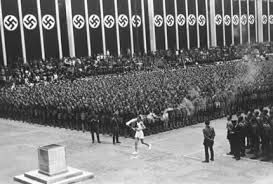
Hitler’s success and supremacy as Chancellor of Germany were undoubtedly influenced by the vast and intense propaganda, used to channel hatred for his enemies and to unite a nation with the same hatred. Hitler was not ashamed of using this propaganda, nor was he afraid to admit he was using it, “Propaganda tries to force a doctrine on the whole people... Propaganda works on the general public from the standpoint of an idea and makes them ripe for the victory of this idea” (“Propaganda,” from Mein Kampf). In 1933, the Reich Ministry of Public Enlightenment and Propaganda was founded to produce Nazi propaganda. German films played a role in promoting anti-Semitism. For example, The Eternal Jew (1940) portrayed Jews as parasites who were driven by money and sex. Newspapers played a central role also, with papers such as Der Stürmer portraying the Jews as subhuman. Propaganda was a ruthless and effective force for the Nazis. Even after losing World War II, prisoners (many of whom were to be gassed shortly afterward) were forced to write letters home proclaiming that they were being treated well in the concentration camps (“Propaganda”).
In 1935, The Nuremberg Laws were declared, explicitly permitting immoral mistreatment of the Jews (a “Jew” was considered anybody with at least one Jewish grandparent). In total, 3.1 million Jews lost all human rights. On “Crystal Night” in 1938, a Polish Jew killed a German diplomat. This sparked a massive outrage of hateful acts. Jewish homes and shops were ransacked and ruined, and all Jews were required to wear a yellow Star of David at all times (“Power”).
Hitler’s final political rise before the war was rapid and successful. He made plenty of daring military moves, all of them violating the agreements set forth in the Versailles Treaty. Germany’s army was grown five times its permitted size, naval building boomed, the Luftwaffe was rebuilt, and Spain was armed by Germany to achieve a fascist victory. The Nazis occupied the neutral Rhineland, dismantled the state of Czechoslovakia, and made a pact of peace with Russia so as to avoid a two-front conflict (“Hitler”). At this point, Adolf Hitler was the all-powerful dictator of Germany, with nearly an entire country willing to stand and fight for his values. He was ready to make the moves that would begin the most deadly, and perhaps the most memorable war in history.
 |
“Crystal Night”
wikipedia.org
|
 |
The Burning of the Reichstag Building
joepwritesthehistoryofberlin.wordpress.com
|
Works Cited:
"Rise of Hitler: The Reichstag Burns." The History Place - Rise of Hitler: Hitler Becomes Dictator of Germany. The History Place, 1996. Web. 06 Feb. 2017.
Meier, David A. "Adolf Hitler's Rise to Power." Hitler's Rise to Power. N.p., 2000. Web. 06 Feb. 2017.
"Nazi Propaganda." United States Holocaust Memorial Museum. United States Holocaust Memorial Museum, n.d. Web. 06 Feb. 2017.
"Adolf Hitler." Jewish Virtual Library. Jewish Virtual Library, n.d. Web. 06 Feb. 2017.