Showing posts with label Historical Context. Show all posts

Wednesday, April 26, 2017

Malcolm X and Black Power


   Malcolm X was born Malcolm Little on May 19, 1925 in Omaha, Nebraska. He was born to parents Louise Norton Little (mom), and Earl Little (father). His father was an outspoken Baptist minister and avid supporter of Black Nationalist leader Marcus Garvey. As a result of Earl’s civil rights activism, the family suffered death threats from the white supremacist organizations forcing the family to relocate twice before Malcolm’s fourth birthday. In 1929, their Lansing, Michigan home was burned to the ground. Two years later, Earl’s body was found lying across trolley tracks. The Littles were certain that members of the Black Legion (white supremacist organization) were responsible however, the police ruled these events as accidents. As a result of these incidents, Louise suffered emotional breakdown several years after and was committed to a mental institution, leaving her children split up among various foster homes and orphanages.


    In 1938, Malcolm X was kicked out of school and sent to a juvenile detention home in Mason, Michigan. He attended Mason High School wherein He excelled academically and was well liked by his classmates. This reality would soon change for Malcolm in 1939, when his English teacher asked him what he wanted to be when he grew up to which he replied with a lawyer. His teacher responded, "One of life's first needs is for us to be realistic. . .you need to think of something you can be. . .why don't you plan on carpentry?" Malcolm X dropped out of school the following year, at the age of 15.


  Malcolm then moved to Boston and found himself caught up in a lifestyle of drug selling and other crimes. In 1946, he and a friend were arrested and convicted on burglary charges causing Malcolm to be sentenced for 10 years and ultimately serving out 7 of those years imprisoned.
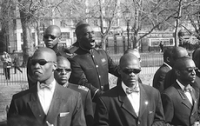
During this period of imprisonment, Malcolm’s brother Reginald would visit and discuss his recent conversion to the Muslim religion. Reginald himself belonged to the religious organization the Nation of Islam (NOI). Consequently he introduced Malcolm to the organization and Malcolm then began to study the teachings of NOI leader Elijah Muhammad. In 1952 Malcolm paroled and was also a devoted follower to the NOI with the new surname “X” (He considered “Little” to be a slave name and chose the “X” to signify his lost tribal name.) Malcolm was later appointed as a minister and national spokesman for the Nation of Islam. Malcolm x was also charged with the task of establishing new mosques in cities such as Detroit, Michigan, and Harlem. Through television, radio and newspaper columns, Malcolm X would communicate the NOI’s message across the United States. Malcolm X was articulate, passionate and inspirational to many. He exhorted black people to cast off racism "by any means necessary," one of which being violence.
"You don't have a peaceful revolution, you don't have a turn-the-cheek revolution. There's no such thing as a nonviolent revolution."
His militant proposals won him large numbers of followers as well as many fierce critics. Ultimately, as a result of his efforts, Malcolm was largely credited with increasing membership in the NOI from around 500 in 1952 to around 40,000 in 1960.


At the height of the civil rights movement in 1963, Malcolm’s faith was greatly damaged. He learned that his mentor and leader, Elijah Muhammad, was secretly having relations with as many as six women within the Nation of Islam organization, some of these relationships resulted in children. This revelation severed Malcolm’s relations with the NOI that would not be fixed again. As a result of a statement Malcolm made on the assassination of President JFK, Elijah Muhammad “silenced” Malcolm for 90 days. Malcolm, however, suspected he was silenced for another reason.


Malcolm X resigned from the NOI and took a trip to Mecca. There he discovered that orthodox Muslims preach equality of the races. Upon his return to the states he continued his engagement with the mainstream of the Civil Rights Movement, however, this time he was now open to voluntary racial integration as a long-term goal. This “new” Malcolm X would be short lived because on February 21, 1965 he was assassinated by members of the NOI at a rally in which he was speaking. three gunmen rushed Malcolm onstage and shot him 15 times at close range, consequently Malcolm died. Interestingly, Malcolm X had predicted that, though he had but little time, he would be more important in death than in life. Foreshadowing of his martyrdom is found in The Autobiography of Malcolm X.


  Malcolm X's ideals became the foundation for the Black Power movement itself. This movement, which gained prominence after Malcolm's death, began in the late 1960s. Its ultimate goal was to achieve “self-determination” for people of African descent. "Black Power" emphasized racial pride and the creation of black political and cultural institutions in order to promote black collective interests and values.


 The term was coined by Stokely Carmichael and Willie Ricks. Together they organized the Student Nonviolent Coordinating Committee (SNCC). This organization was committed to  nonviolence, however, the "Black Power" movement as a whole transitioned into more violent actions. One of the more violent and infamous groups were The Black Panther Party. This
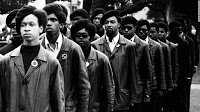
organization was dedicated to socialism through the medium of violence. After years of violence, many left the movement and the police began arresting violent partakers within the movement.


Works Cited
"Biography." Malcolm X. N.p., 10 Feb. 2015. Web. 25 Apr. 2017.
http://malcolmx.com/biography/


History.com Staff. "Malcolm X." History.com. A&E Television Networks, 2009. Web. 25 Apr. 2017.
http://www.history.com/topics/black-history/malcolm-x


Fairclouth, Adam. "BBC - History - Better Day Coming: Civil Rights in America in the 20th Century." BBC News. BBC, 2003. Web. 25 Apr. 2017.
http://www.bbc.co.uk/history/recent/civil_rights_america_04.shtml


Muir, Hugh. "Malcolm X: the man behind the myth." The Guardian. Guardian News and Media, 07 Apr. 2011. Web. 25 Apr. 2017.
https://www.theguardian.com/world/2011/apr/07/malcolm-x-man-behind-myth

Monday, April 24, 2017

Origins of the Black Lives Matter Movement

The Black Lives Matter Movement, is a movement created  in 2013 and started by three African American women named Alicia Garza, Opal Tometi, and Putrisse Cullors. The event that sparked these three women to take action was the murder of 17-year-old Trayvon Martin and the court case finding George Zimmerman not guilty of murder and manslaughter. Garza says that the creation of the movement "was a response to the anti-black racism that permeates our society and also, unfortunately, our movements" (Garza). According to Garza, the Black Lives Matter movement, "is an affirmation of Black folks' contributions to this society, our humanity, and our resilience in the face of deadly oppression".


The Black Lives Matter movement has drastically grown in popularity and recognition since its creation in 2013. Along with a mention on the television show Law and Order: SVU it has sparked countless other social movements such as brown lives matter, migrant lives matter, and migrant lives matter. This has been very good for society because it has brought recognition to all sorts of different kinds of oppression. Garza says that she does not mind any other group imitating the Black Lives Matter movement to bring awareness to oppression as long as it does not celebrate the imprisonment of any individual and it acknowledges the the Black Lives Matter to be the origination of the movement. She goes on to express her anger that certain groups have attempted to modify the movement in ways that take away from its intended purpose. Garza claims that it is not right that some groups are transforming the Black Lives Matter movement into something that actually takes away from the work put in by many African Americans. Garza says that there is no reason to change the specific call and demand around black lives. In fact, Black Lives Matter has even issued a series of non-negotiable demands that include:

  • An end to discrimination and the full recognition of Black's human rights
  • An immediate end to police brutality and to the murder of black people and all oppressed people
  • A public education system that teaches the rich history of Black people
  • Access to affordable healthy food for their neighborhoods
and many more. It is very upsetting to know that these have to be demanded. These seem like they should be assumed rights for everyone in the world. However, the Black Lives Matter movement is forced to take action to gain some of the most basic human rights.

A big advocate for the Black Lives Matter movement that has made the headlines recently is NFL quarterback, Colin Kaepernick. Kaepernick first made headlines when he decided not to stand up during the playing of the national anthem before one of his games. Kaepernick believed that he shouldn't stand for a flag that represents a country that is doing so much to oppress people of color.


Despite some taking this as an act of disrespect towards our flag and our country, this sparked a widespread movement across the country of athletes showing their solidarity together by either kneeling, not standing up, or putting a fist into the air. This did a lot to help the Black Lives Matter movement to gain traction because it made many other athletes feel comfortable enough to speak their mind about oppression.

The Black Lives Matter movement has been one of much controversy ever since its beginning in 2013. However, I feel that most of this controversy would disappear if much of its opposition would just hear out those who are calling for change. Instead of dismissing the movement, it would greatly benefit many people to educate themselves on the origin of this movement in order to see where its founders are really coming from.

Sources
"Black Lives Matter: Understanding Its Origins, History, and Agendas." Right Side News. N.p., 12 July 2016. Web. 25 Apr. 2017.

 Garza, Alicia. "A Herstory of the #BlackLivesMatter Movement." Black Lives Matter. N.p., n.d. Web.

Craven, Julia. "Black Lives Matter Co-Founder Reflects On The Origins Of The Movement." The Huffington Post. TheHuffingtonPost.com, 30 Sept. 2015. Web. 25 Apr. 2017.


 Baptiste, Nathalie. "The Rise and Resilience of Black Lives Matter." The Nation. N.p., 09 Feb. 2017. Web. 25 Apr. 2017.

Racial Disadvantages in the Criminal Justice System

            Criminal Justice system is defined as a system the government created to control crime and penalize those who violate the law. Yet there are countless times where history proves to us that it was created to a disadvantage for the African Americans. Instead, it seems more like a way people could gain control, power, and advantages over the African Americans (since they were considered as the minority group). Statistics have shown that even though they only take up about 13% of the entire population in America, 38% are punished and put in jail. 

            From as early as the early establishment of the U.S Constitution 1787, we can see how the law plays a disadvantage role for them. African Americans were once considered as 3/5th of a citizen in the constitution. Through history, we can see that there was a significant difference in the administration of justice when people were reviewing for punishment for crimes committed for both White and African Americans. For example, if an African American commits a crime, they would have to endure many biased juries who will often find reasons to prove them guilty. On the other hand, if a White American commits a heavy crime such as lynching or raping an African America, they were often proven innocent, granting them a free pass.

            Looking back in time, from the 1630-1865s many believed that “black life is cheap”, thinking that they weren’t capable of affording justice, they devalued African Americans by giving little justice to them compared to White Americans. At the time of slavery, history has already shown the marginalization and flawed bias in the criminal justice system. African Americans were seen as inferior to the Whites, and sold into labor to help boost the economy in the south. Slave codes were later established for anyone who tried to escape or fight against this slave life that was forced upon them. From example like these, we can see how the idea of whites being more superior than blacks are heavily weighted into the definition of what the justice system is like and should be. 

            Focusing especially on the slave code, it shows the injustice that the law created. Even though the action of slave trading often mean innocent African Americans being abducted, traded, and sold, very few whites were convicted or executed for their heartless action. Since people believed that death would be too big of a punishment for trading slaves, these white slave traders were considered “innocent”. Even after 1863 where slaves were free through the Emancipation Proclamation, black codes were still passed as laws to punish blacks who would “offend” the whites by testifying against them in voting or in juries. 

            Even recently, we can see the flaws in the criminal justice system through events such as the Trayvon Martin shooting case. An innocent 17 year old African American boy was shot by a watchman because of what supposedly was “self defense”. The boy was unarmed and was killed because the white watchman was overzealous and claimed it to be self defence. The justice department ended up charging this white watchman for civil rights violation, and was sparred all other charges because there was not enough evidence against the white watchman. 

            Examples like these show how the criminal justice system in America often turns a blind eye towards the white, which gives them the power to suppress and often control the African Americans socially. It gives us a glimpse into the injustices and inequality African Americans have been experiencing with this flawed criminal justice system. 

""Slave Codes"." Ushistory.org. Independence Hall Association, n.d. Web. 23 Apr. 2017.

Parent, Anthony S. "Foul Means." Google Books. N.p., n.d. Web. 23 Apr. 2017.


The System Isn't Broken, It Was Designed That Way: A Critical Analysis of Historical Racial Disadvantage in the Criminal Justice System I The Hampton Institute. N.p., n.d. Web. 23 Apr. 2017.

"Trayvon Martin Shooting Fast Facts." CNN. Cable News Network, 28 Feb. 2017. Web. 23 Apr. 2017.

The Criminal Justice System. N.p., n.d. Web. 23 Apr. 2017.


Wednesday, April 19, 2017

Brown v. Board of Education

Brown v. Board of Education


Mother talks to daughter after segregation 
is declared unconstitutional in schools

Brown versus Board of Education is a monumental case that helped change the educational system. When looking at this court case, the Plessy v. Ferguson case has to be observed in order to understand the background circumstances that were occurring. In 1892, Homer Plessy refused to give his seat on a train up to a white man. Since he was required by law to do so, he was arrested and eventually he took his case to the Supreme Court. They ruled against him and allowed for Jim Crow laws and discrimination to continue to occur. The 1896 Plessy v. Ferguson allowed for separate but equal public schools and facilities.
In 1950, Oliver Brown attempted to enroll his African American daughter into a white school. His daughter, Linda Brown, and her sister had to walk through a dangerous railroad yard to get the bus to take them to an all black school. The white school was closer to their house but the federal district dismissed Brown’s claim and said that the two schools were equal enough to fit under the Plessy v. Ferguson doctrine. Brown appealed his case to the Supreme Court, and this case along with Briggs v. Elliot, Davis v. Board of Education of Prince Edward County, Boiling v. Sharpe, and Gebhart v. Ethel became known collectively as Brown v. Board of Education in 1952. All five of the cases were based on the constitutionality of state sponsored segregation in public schools.
Thurgood Marshall, who was the chief counsel of the NAACP, argued in this case that the separate schools were unequal and violated the equal protection clause of the fourteenth amendment. He stated that black children felt inferior to white children due to segregated schools. There were also studies done that showed that black girls had low racial self esteem. One of these studies, the Doll Test, was used as evidence in the Supreme Court case. The Doll Test tested African American children between 3 years old and 7 years old by showing them four dolls with different races. The children had to identify the races of each and say which one they preferred. Many of the black children chose the white doll and gave it positive traits. Some said the black dolls were bad and said that the white ones looked the most like them. Lawyers argued that this showed the inferiority that the black children felt due to the segregated schools.

One of the dolls used in the Doll Test


Most of the justices on the Supreme Court wanted to reverse Plessy and thought segregation was unconstitutional, but they each had different reasons for this. When there still was not a solution by June 1953, the case was decided to be reheard in December of 1953. In the meantime, Earl Warren replaced Fred Vinson as chief justice after Vinson passed away. Warren was able to bring the justices together to declare segregation in education unconstitutional. They said the fourteenth amendment guarantees equal education for everyone. They also stated that education is the basis of a person’s life and if this right was denied, people were less likely to succeed. The Supreme Court asked the state attorney generals to submit plans for how to get rid of segregation. In the second hearing of the Brown case, or Brown II, in May of 1955, the Supreme Court said desegregation was to proceed with “all deliberate speed”. This did not immediately solve the problems because this statement is vague and hard to enforce. However, the case of Brown v. Board of Education greatly impacted education and the role that segregation played in society.

Works Cited

"Brown v. Board of Education." Uscourts.gov. U.S. Courts, n.d. Web. 15 Apr. 2017.
History.com Staff. "Brown v. Board of Education." History.com. A&E Television Networks, 2009. Web. 15 Apr. 2017.
"Kenneth and Mamie Clark Doll." National Park Service. N.p., n.d. Web. 15 Apr. 2017.
"Landmark Cases of the U.S. Supreme Court." Brown v. Board of Education | Www.streetlaw.org. N.p., n.d. Web. 15 Apr. 2017.
McBride, Alex. "Brown v. Board of Education." PBS. Public Broadcasting Service, Dec. 2006. Web. 15 Apr. 2017.
"NAACP Legal Defense Fund : Defend, Educate, Empower." Brown at 60: The Doll Test | NAACP LDF. Legal Defense and Educational Fund, n.d. Web. 15 Apr. 2017.

Monday, April 17, 2017

Emmet Till 
Emmett Louise Till was born on July 25, 1941 in Chicago, Illinois. He was raised in a middle class black neighborhood on the South Side of Chicago. His neighborhood was full of black-owned businesses therefore he was used to living in a place where black people could thrive. Emmett was described as being responsible, funny, and an infectiously high-spirited child, and was also known for having a speech impediment. When he was 14 years old his great uncle Moses Wright came from Mississippi to visit Emmett’s family. When his uncle left with Emmett’s cousin Emmett wanted to go with them to spend time with his cousins and begged his mother to allow him to go to Mississippi. Reluctantly his mother agreed and this decision would forever be remembered.
Three days after Emmett had arrived in Mississippi on August 24, 1955 he and a group of teenage boys entered Bryant’s Grocery and Meat Market to buy some drinks after being outside all day. The woman working at the cash register, Carolyn Bryant claimed Emmett Till flirted with her by asking for a date and grabbed her hand. She was the wife Roy Bryant who was the owner of the store, and she told her husband about what had happened. Four days after the boys entered the store, at approximately 2:30 am on August 28, 1955 Roy Bryant and his half brother J.W. Milam kidnapped Till from Moses Wright’s house. Then Till was beaten brutally, dragged to the bank of the Tallahatchie River, shot in the head, tied with barbed wire to a large metal fan and his body was shoved into the water. Till’s uncle Moses reported his disappearance to the local authorities and three days later Till’s body was pulled out from the river. His face was so disfigured that he was unrecognizable, and the only way his uncle Moses was able to identify Till was by the ring on his finger that was engraved with his father’s initials “L.T.” After the body was found it was shipped to Chicago. There his mother, Mamie Till decided to have an open-casket funeral and her reasoning was to, “Let the world see what has happened, because there is no way I could describe this. And I needed somebody to help me tell what it was like.”
The kidnapping and murder trial of Roy Bryant and J.W. Milam began on September 19, 1955 and the final verdict was reached on September 23, 1995. Regardless of the tremendous amount of evidence and pleas for justice, the panel of all white male jurors acquitted Bryant and Milam of all charges. The deliberation lasted for 67 minutes. Four months later in January 1956 the two men Bryant and Milam confessed to Look magazine in exchange for $4,000, that they did in fact commit the crime. Because of double jeopardy laws the men were protected and could not be sent to trial again, so they freely told the entire story.
The death of Emmett Till was crucial in triggering the American Civil Rights Movement. Although Mamie Till could never get over the pain of losing her son, she did understand that what had happened to Emmett Till was able to open the eyes of America to the racial hatred that was tormenting the country. Also, by opening their eyes it allowed for a substantial protest movement for racial equality and justice. Only 100 days after the murder of Till, Rosa Parks refused to give up her seat on an Alabama bus. This then caused the yearlong Montgomery Bus Boycott. Nine years after the Boycott, Congress passed the Civil Rights Act of 1964. This Act then outlawed various forms of racial discrimination and segregation. Then one year later in 1965 the Voting Rights Act was passed which outlawed discriminatory voting practices.
The trail of Emmett Till is still not completely over. As of 2007 Carolyn Bryant admitted to lying about what she said Till had said/ done to her while in the market. She confessed to Timothy Tyson who then wrote about it in his book entitled, The Blood of Emmett Till. This does not change the outcome of the trail because the damage has already been done. However, it does exhibit a modern testament to the racist and unfair legal system that has long refused to give African- American people fair treatment and judgment.

Works Cited:
“Emmett Till.” Biography.com. A&E Networks Television, 27 Jan. 2017. Web. 15 Apr.   2017.
“The death of Emmett Till.” History.com A&E Television Networks, n.d. Web. 15 Apr.   2017.
“Emmett Till.” Wikipedia. Wikimedia Foundation, 13 Apr. 2017. Web. 16 Apr. 2017.
“Emmett Till Murder.” Famous Trials. N.p., n.d. Web. 15 Apr. 2017.
USATODAY. “What’s next for Emmett Till’s accuser after she lied.” YouTube. YouTube, 08 Feb.         2017. Web. 14 Apr. 2017.