Wednesday, February 15, 2017


The aftermath of the attack on Pearl Harbor

            Yesterday, December 7, 1941 — a date which will live in infamy — the United States of America was suddenly and deliberately attacked by naval and air forces of the Empire of Japan.”

            These well-known words are the opening line of Franklin D. Roosevelt’s address to Congress on December 8, 1941, following the bombing of Pearl Harbor by Japanese airplanes. This address was made by President Roosevelt to request that Congress declare war on the Empire of Japan for their unprecedented yet clearly intentional attack on the United States, and it was the first step of a rapid growth of anti-Japanese sentiment in the United States of America.

            During the spring of 1942, following Pearl Harbor, President Roosevelt’s address Congress, America’s entry into World War II, and an official edict from the president, almost 120,000 Japanese-American citizens were forced to leave their homes on the West Coast of America—primarily from California, Oregon, Arizona, and Washington—as well as some of the Japanese population of Hawaii, and enter government or military-controlled internment camps. Approximately 112,000 of all of these prisoners were from the West Coast, and made up less than two percent of the population of the aforementioned states.

However, in Hawaii, internment worked differently than on mainland America. Because there was such a high concentration of Japanese and Japanese-Americans in Hawaii (approximately 32% of the islands’ population), those who were interned were primarily “religious leaders, local business owners and people… who went to school in Japan (SOURCE).” This removed the entire system of leadership from a huge community on Hawaii. It was a selective process that targeted the most influential members of the Japanese/Japanese-American community on the islands, yet was also very strategic.

These community leaders, as well as many other people of Japanese ancestry, were rounded up beginning just hours after the bombing of Pearl Harbor. Those who were actually interned were primarily the male leaders of the community, although a handful of women were imprisoned as well. According to the Japanese Cultural Center of Hawai’i, “[this] abrupt aftermath diminished the quality of life for many local Japanese, stripping dignity and separating families. Children often had minimal contact with their fathers, and many people didn’t even know if their loved ones were alive long after they were taken away (SOURCE).”
Sand Island Internment Camp

There were two major internment camps in Hawaii. The first camp was the Sand Island camp. It initially housed its prisoners in tents for a full six months before the barracks were completed. In February of 1942, the government decided to move the Sand Island internees to Mainland camps, and gave their families the option to join them. Over 1,000 women and children followed their loved ones to camps in Texas, California, and Arkansas.
Honouliuli Internment Camp

The second Hawai’i internment camp was the Honouliuli camp, which was opened on March 1, 1943. It was situated in a gulch in the center of O’ahu, but was only one of five local sites used to house local Japanese who had not been convicted of any specific crimes but were still being detained by the United States government. Honouliuli’s location was kept secret, but was rediscovered in 2002 by volunteers from the Japanese Cultural Center; President Obama declared it a national monument in February of 2015. The 160 acres that Honouliuli spanned are now covered in heavy foliage, but it was once patrolled by armed guards, and “lined with double barbed-wire fences and guard towers (SOURCE).” It is unclear how many prisoners were kept in Honouliuli; the camp was built to house 3,000 people, but some say that its population reached 3,200, while others say it may have peaked at as high as 4,000 occupants.

Those who were interned in Honouliuli were allowed visits by their families. These families would board buses in downtown Honolulu, then would be blindfolded before the drive to the gulch where Honouliuli was located. Additionally, since “engaging in Japanese cultural activities became a sign of disloyalty, many traditions were suppressed (SOURCE).” This suppression affected multiple generations following the actual internment. Many subjects of internment find the experiences too painful to talk about, although some insist that it is “important to preserve this history for younger generations and to document it as thoroughly as possible to prevent similar discriminatory acts from happening again (SOURCE).”


Sources:
Roosevelt, Franklin D. "Request for a Declaration of War." Annals of American History. N.p.,
n.d. Web. 14 Feb. 2017.
Rostow, Eugene V. "Our Worst Wartime Mistake." Annals of American History. N.p., n.d.
Web. 14 Feb. 2017.
Solomon, Molly. "Once Lost, Internment Camp In Hawaii Now A National Monument." NPR.
NPR, 16 Mar. 2015. Web. 14 Feb. 2017.
"The Untold Story." The Untold Story | JCCH - HAWAII INTERNMENT CAMP. N.p., n.d. Web.

14 Feb. 2017.

Tuesday, February 14, 2017

Class Session Summary: Tuesday, February 14


The Hiding place chapter 11-15

Today our class timing changed a bit due to snow day and chapel. We start the class by finishing the timeline of historical event that took place in the Hiding Place. The timeline of continuing chapters 3, 4 and 5 was being presented to class. In the chapter 3 timeline presentation we looked at Europe as a whole and the important lessons Corrie learned from her parents. In the chapter 4 timeline presentation was about the grows of Nazi regime, the world economy and the struggles of Corrie about her mother's sickness. Lastly the chapter 5 timeline presentation was on the Nazi occupation of Holland and Ten Boom’s family reaction to the invasion.

From there with the help of powerpoint we continued discussing a bit more of the timeline of Nazi invasion of Holland. Europe was consistently in war and the rise of Hitler led to  WWII taking place. Germany wanted more territory, therefore reclaiming the land that once belonged to Germany created time for many battles. In fact Holland was especially important to Hitler, for he wanted to invade France through Holland.

Afterwards we took some time looking to pictures of the house Corrie lived in. They build the hiding spot in their house for Jews. Then we were shown some pictures of Ravensbruck the concentration camp where Corrie was being sent. Through pictures we learned more about the conditions of the time.

With  these principles in mind, we were taught the difference between autobiography, memoir and spiritual memoir. We learned that Hiding Place falls underneath of the spiritual memoir. We raised the issue why Corrie’s perspective had played an important role in the novel. That led us to discuss how we can have better reading responses for the class. From our past reading responses where there was too much generalization we learned how to zoom in on a specific aspect of the novel. We discussed the ways how as readers we can interpret the meaning of the novel by having characters interpretation as our evidence.

Later on we took a minute to deepen our thinking about the main question of the novel by having a discussion. How can we decide to which perspective is more accurate and right. Either Corrie or Nollies ?
Some examples can be found on pages 107-108 and pages 125-127. We discussed the perspective of Corrie’s and Nollies on whether to lie or to not lie. Where do we see the both of the perspectives in the text and what bible tells us about it? We ended up coming to the conclusion that it was a complicated matter on the perspectives.

Second to last we look on how to make interpretive arguments. As a class we discussed the consequences when a human rights violated, such as for a boy to dress up as girl for their safety. The mentality of the survivors for example being free physically but mentally still trapped. It might lead a person to become more selfish. We discussed the term refuge and the implication of refuge as being secure, safe and accepted. Perhaps the passage from the psalm on page 39 is the reason for this book to be titled the Hiding Place. God is our hiding place, when we have something to hide from.  

Lastly we had discussion about the story of the Karel and the importance for the novel. Corrie’s love for other was a fulfillment of God’s purpose for her life. She didn’t have a romantic human connection but rather deeper relationship with God. Also through story of Karel’s romance we were able to see Corrie as a human and relate more to her.  Overall we learned that God have a bigger plan for us. An example of this can be found on page 61-”It is a happy thought not a sad one”.....For next class we will look at divine Empire and have discussion on U.S.

Monday, February 6, 2017

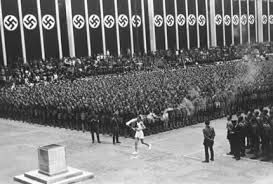
Games of the XI Olympiad
In 1931, the International Olympic Committee made a decision for the 1936 Summer Olympics to take  place in Berlin. Due to Germany’s  defeat  in WWI, it was seen as a peaceful gesture to award Berlin the honor of hosting the Olympics games, and as a way of welcoming them back into the world community.
  However in 1933, when the Nazi party leader Adolf Hitler become German chancellor, Germany began to change rapidly. The basic rights of German citizens began to be taken away. The power of the Nazi regime started to establishing the concentration camps, imprisoning political opponents, and persecuting Jews. Basically Nazi ideas were shaping  and controlling the whole of German life, even in the sports.
“In April 1933, an "Aryans only" policy was instituted in all German athletic organizations. "Non-Aryans"—Jews or individuals with Jewish parents and Roma (Gypsies)—were systematically excluded from German sports facilities and associations”(United States Holocaust Memorial Museum). The atletlhes like Erich Seelig and Daniel Prenn were not allowed to compete in Olympics just for being Jewish.
This unjust treatment of Jew athletes has been heard around the world. Therefore three years before the game took place, a boycott movement was debated and argued upon between the U.S.,  England, France and some other countries. Diplomats believed that games would only help Hitler’s Nazi regime to spread nation wide. And joining the games in Berlin would mean that they are supporting the idea of discrimination against Jews. But then the U.S. itself had racist attitudes towards African-Americans, and discriminate towards black athletes. In the end,  the decision of the Amateur Athletic Union of the United States voted for the U.S., to join the Olympics in Berlin. Afterwards other countries followed the U.S. and the boycott movement failed.
On August 1, 1936, when the 11th Olympic Games were opened by Adolf Hitler, his racist policies during the games were camouflaged. The anti-Jewish signs were ordered to be removed temporarily. The main purpose was to announce that Germany is peaceful and tolerant, which led most people to believe that Germany was changing positively. The New York Times stated that, “‘Games put Germans "back in the fold of nations,’ and even made them ‘more human again.’” (Berkes). Little did most people know that the games were the perfect opportunity for the Nazis to introduce their idea of the “Master Race” to the world.
Hitler tried hard to show the world the power of Aryan racial superiority during the games. By making sure that the games were broadcasted on televisions and radios. Perhaps it was partly some of his efforts that helped the Olympics to become broadcasted on radio in 28 different languages.
At the end of the Olympics, the world saw the victory of Jesse Owen, and African-American sprinter and long jumper. He won three individual events and a four gold medals. Jesse Owen was the opposite picture of the Aryan race, and he was what people remembered of the 1936’s Olympics, not Hitler’s idea of the “Master Race”.


Citation
"Berlin 1936." International Olympic Committee. N.p., 31 Jan. 2017. Web. 06 Feb. 2017.
Berkes, Howard. "Nazi Olympics Tangled Politics and Sport." NPR. NPR, 7 June 2008. Web. 06 Feb. 2017.
C N Trueman "The 1936 Berlin Olympics"historylearningsite.co.uk. The History Learning Site, 9 Mar 2015. 16 Aug 2016.
United States Holocaust Memorial Museum. United States Holocaust Memorial Museum, n.d. Web. 06 Feb. 2017.

The Rise of Adolf Hitler

Adolf Hitler was an awful human being. He called for the murder of at least 11 million people in concentration camps, and he sparked a war that resulted in 70 million people dead. His views were based upon racism, hatefulness, and a political ideology that made illegal the slightest opposition to his bigoted views. It is easy and reasonable to dislike Adolf Hitler, but it should go without dispute that he was a genius. He did not rise to power with the snap of his fingers, but he rose by playing his cards perfectly in the right places, for a long time. In nearly every metric, Adolf Hitler managed to capture the hearts of a desperate class of broken Germans who were willing to embrace almost unthinkable ideologies because of their brokenness. Adolf Hitler rose to power because he knew how to persuade people, and he knew how to get them to do exactly what he wanted.
            Adolf Hitler was the son of the Austrian customs official, Alois Hitler and his third wife, named Klara Poelzl (“Hitler”). In general, Hitler grew up hostile towards authority, potentially because of the strictness of his father and his mother’s death to cancer in 1908. When he grew up, Hitler’s first ambition was to become an artist (“Hitler”). Unfortunately for him, he was rejected by the Viennese Academy of Fine Arts, crushing his dreams of ever being realized as a great artist. The already bitter Hitler began to develop hateful ideas of anti-Semitism as a homeless man in Vienna. He grew in his hate for a number of years (“Hitler”).
            In the First World War, Hitler joined the 16th Bavarian Infantry, where he fought as a great and an oddly brave soldier. He earned the Iron Cross for his bravery. After losing the war, Hitler decided it was fate that chose him to save his country from the oppression of the Versailles Treaty, and from the Bolsheviks and Jews whom he hated (“Hitler”). Hitler quickly entered the German Workers Party and gained favor in it. Eventually, the party was renamed the National Socialist German Workers Party (NSDAP). By 1921, Hitler became the chairman of this group. In power, he instituted the swastika as its symbol and “Heil!” as its slogan (“Hitler”).
            With the party, Hitler organized strong-arm squads to keep order in the group. With these squads, Hitler gave his first speech in a Beer hall full of people held at gunpoint. His speech was charismatic, and he appealed to many (“Hitler”). With some support, Hitler marched through Munich with 3,000 men. They were met with police retaliation, and 16 people were killed. For this, Hitler was arrested in February 1924, and he was tried and sent to prison. Wasting no time, Hitler wrote what may have been his most important piece of propaganda, Mein Kampf, sitting in prison. Later, in 1925, Hitler and the Nazi Party went free (“Hitler”).
            Upon the collapse of the world economy in 1929, the people of Germany were more desperate than ever, further increasing their desires for a dictator who would save them. Eventually, Hitler ran for president of Germany, gaining an impressive number of votes, but still losing to Paul von Hindenburg. This impressive campaign put him in place to win the next important election, where he was nominated as Reich Chancellor in 1933 (“Hitler”). From here, Hitler’s goal was to have the Nazis take control over the Reichstag (sort of like Congress). To do this, Hitler used propaganda and false claims to destroy the legitimacy of his greatest political opponents, the communist party (“Hitler”).
            President Hindenburg seemed to be willing to agree to whatever proposition Hitler set forth as the new Chancellor of Germany. Upon request, the Nazi storm troopers were granted the power and capabilities of the police, so that those who were persecuted by the party had no one to turn to for help or compensation (“Burns”). Stormtroopers proceeded to march into the communist headquarters in Berlin. All the members of the party were found and arrested. Furthermore, the Nazi leaders Göring and Goebbels constructed a plan to burn down the Reichstag building. An arsonist, named Marinus van der Lubbe, was allowed inside the Reichstag. He was encouraged by soldiers to burn down the building, using his shirt as a torch. The burning was a success, and Hitler quickly blamed the “catastrophe” on the communist party, “The German people have been soft too long. Every Communist official must be shot. All Communist deputies must be hanged this very night. All friends of the Communists must be locked up. And that goes for the Social Democrats and the Reichsbanner as well!” (“Burns”). Germany seemed to believe him. Shortly after, a freedom-violating proclamation was made, “Restrictions on personal liberty, on the right of free expression of opinion, including freedom of the press; on the rights of assembly and association; and violations of the privacy of postal, telegraphic and telephonic communications and warrants for house-searches, orders for confiscations as well as restrictions on property, are also permissible beyond the legal limits otherwise prescribed” (“Burns”). With this, free speech was officially condemned in Germany, and the rights of the people were heavily infringed. Great roundups took place, with thousands of communists, liberals, and other political opponents. The Nazis proceeded to beat and torture these people. In the words of Hermann Göring, “I don't have to worry about justice; my mission is only to destroy and exterminate, nothing more!” (“Burns”).
On March 5th, it was election day in Germany. With propaganda and the recent burning of the Reichstag, the Nazi party gained 44% of election votes. Along with their allies, the conservative nationalist allies, the party gained the majority of the Reichstag, with 340 out of 647 seats (“Power”). Moreover, none of the 81 communists were permitted to take their seats, further increasing the Nazi influence. In the Enabling Act of March 1933, Hitler and his party were granted dictatorial power in Germany for at least four years. By July, German politics were so manipulated that it became illegal to be part of any political group other than the Nazi Party (“Power”).
            Hitler’s success and supremacy as Chancellor of Germany were undoubtedly influenced by the vast and intense propaganda, used to channel hatred for his enemies and to unite a nation with the same hatred. Hitler was not ashamed of using this propaganda, nor was he afraid to admit he was using it, “Propaganda tries to force a doctrine on the whole people... Propaganda works on the general public from the standpoint of an idea and makes them ripe for the victory of this idea” (“Propaganda,” from Mein Kampf). In 1933, the Reich Ministry of Public Enlightenment and Propaganda was founded to produce Nazi propaganda. German films played a role in promoting anti-Semitism. For example, The Eternal Jew (1940) portrayed Jews as parasites who were driven by money and sex. Newspapers played a central role also, with papers such as Der Stürmer portraying the Jews as subhuman. Propaganda was a ruthless and effective force for the Nazis. Even after losing World War II, prisoners (many of whom were to be gassed shortly afterward) were forced to write letters home proclaiming that they were being treated well in the concentration camps (“Propaganda”).
            In 1935, The Nuremberg Laws were declared, explicitly permitting immoral mistreatment of the Jews (a “Jew” was considered anybody with at least one Jewish grandparent). In total, 3.1 million Jews lost all human rights. On “Crystal Night” in 1938, a Polish Jew killed a German diplomat. This sparked a massive outrage of hateful acts. Jewish homes and shops were ransacked and ruined, and all Jews were required to wear a yellow Star of David at all times (“Power”).
Hitler’s final political rise before the war was rapid and successful. He made plenty of daring military moves, all of them violating the agreements set forth in the Versailles Treaty. Germany’s army was grown five times its permitted size, naval building boomed, the Luftwaffe was rebuilt, and Spain was armed by Germany to achieve a fascist victory. The Nazis occupied the neutral Rhineland, dismantled the state of Czechoslovakia, and made a pact of peace with Russia so as to avoid a two-front conflict (“Hitler”). At this point, Adolf Hitler was the all-powerful dictator of Germany, with nearly an entire country willing to stand and fight for his values. He was ready to make the moves that would begin the most deadly, and perhaps the most memorable war in history.

“Crystal Night”
wikipedia.org

The Burning of the Reichstag Building
joepwritesthehistoryofberlin.wordpress.com

Works Cited:
"Rise of Hitler: The Reichstag Burns." The History Place - Rise of Hitler: Hitler Becomes Dictator of Germany. The History Place, 1996. Web. 06 Feb. 2017.
Meier, David A. "Adolf Hitler's Rise to Power." Hitler's Rise to Power. N.p., 2000. Web. 06 Feb. 2017.
"Nazi Propaganda." United States Holocaust Memorial Museum. United States Holocaust Memorial Museum, n.d. Web. 06 Feb. 2017.
"Adolf Hitler." Jewish Virtual Library. Jewish Virtual Library, n.d. Web. 06 Feb. 2017.

Reading Response #2: The Hiding Place

One of the rights listed in the UDHR is the "freedom of thought, conscience and religion; this right includes freedom...to manifest his religion or belief in teaching, practice, worship and observance.of religious expression." Corrie Ten Boom's memoir, The Hiding Place, offers us one family's experience of how their religious faith both propelled them into suffering and sustained them through it.

For this reading response, I want you to think about what The Hiding Place teaches us about faith in suffering. Choose two moments from the book and demonstrate how Corrie Ten Boom's experience provides an illustration of the value and role of faith during intense hardship. Make sure to make connections between the two instances you choose: do we see her faith develop over the course of the novel? How so? How does her faith operate differently under different circumstances? What do we learn about the faith of the characters in each instance, but also, what do we learn about God's faithfulness?

This response is due by the end of the day on Tuesday, Feb. 14 (I will say a few things in class about how to write these responses, so I'd encourage you to draft a response and then come to class and see how you might revise.)

Thursday, February 2, 2017

Class Notes 2/2

Today we went over the poem "Shema", written by a Holocaust survivor. He addresses all of those "who live securely in their warm houses". In other words, those who are not threatened by the Holocaust victims. He urges that we must repeat this to our children and we should remember those who are less fortunate than us. The author portrays a struggle to put food in the mouths of his family after the devastation of the war. They used to have something. He works at a gruesome job while he watches his wife (dream) slowly die. He urges people to share money with the needy and being empathetic towards those in need. 
The next poem we discussed was "When Death Comes" by Mary Oliver. Her version of death is portrayed as sudden and unavoidable, strong and powerful. She imagines the arrival of death in several ways. As a bear, a man with a coin purse, a disease, an iceberg. She tells us that when death comes, she wants to dies full of curiosity. She explains that because she will die and/or because she wants to die full of curiosity. She compares each life to a flower, in its commonness but also its individuality. When she dies she wants to be able say that she knew the world intimately, and embraces it with open arms. She tells us that she doesn’t want to be afraid or angry. She wants to have truly lives in this world, not just experienced it as a visitor. 
The third poem we talked about was by Wislawa Szymborska, "On Death Without Exaggeration". She portrays death as weak and awkward, powerless, messy, lazy, not efficient "comes too late", pointless and unpredictable. She suggests that in order to cope with the inevitable existence of death, one must downplay the seriousness of its nature and characteristics. It can't take a joke, find a star, make a bridge. And we compared these three poems to The Book Thief. We concluded that Death in the novel is sympathetic, methodical, and it isn't something we should be fearful of. 
Then, we went around the room and each person talked about what stood out to us in the reading. We talked a lot of the link between Death and Liesel, the foreshadowing of death, and the corruption of youth. In the beginning and end of the story Death says he would visit Liesel three times, and each time she escaped Death. Death did not catch hold of Liesel. Diesel symbolizes the glimmer of hope for the people who didn't die. She and Max are the ones who weren't suppose to live, but did. The foreshadowing of Death says that he would take three people in the book. We talked about how it doesn't really have an impact on us towards the beginning of the book because we haven't gotten a feel for the characters yet. But, as we read and develop an attachment to certain characters, the deaths revealed at the end of the book make it extremely difficult for readers to come to terms with. The corruption of the Hitler Youth camps are hard to read, especially when young boys are acting malicious towards their own peers such as, Rudy. The youth are the the future leaders of the country and Hitler brainwashes them with propaganda and persuasive tactics to get them to be loyal to him. In the book, Rudy was beaten when he was making light of not knowing Hitlers birthday. Well, the Hitler Youth didn't think it was all that funny, and beat Rudy up.
Then, Professor West went over the PowerPoint covering the Holocaust. The Holocaust was the killing of six million Jewish men, women, and (1 million) children and millions of others by Nazi Germany and its collaborators during WWII. Hitler's goal was to exterminate the whole Jewish people and subordination and control of other races. He believed that humans can be organized into separate and distinct races. He also believed that some people are more fit to rule than others, and they have obligation to exercise their natural dominance, said Hitler. He enacted the Nuremberg Laws that slowly excluded from all forms of German life. But, what we know is the race is not a biological category, homosapiens contain no sub classes, and we have this christian perspective that all humans are made in God's image.

Wednesday, February 1, 2017

The Book Thief Reading Response

I always knew much about the Holocaust and how the Jewish people were persecuted, but never thought to focus on how the Germans were affected. It is like that for most people. Human rights seemed to be obsolete to many. When they think of Nazi Germany, they reflect on what happened to the Jews, and not so much on what it meant to be a citizen of Nazi Germany. Reading the Book Thief by Markus Zusak, opened my eyes to that ordeal. Though the Jews were suffering at a much higher capacity, the blonde haired, blue eyed bodies still had to watch their backs at all costs. The Hubermann’s faced many obstacles in their everyday lives. From barely getting enough food for survival to hiding a Jew in the basement, being a German citizen in the days of Hitler were not easy.

One of the things that stood out to me in The Book Thief was that even if you were just a regular German citizen, you could still not live the way you wanted. You had to live up to a certain stigma. For example, in the book where Liesel said out in public that she hated Hitler, she was slapped in the face by Hans. "I hate the Führer. […] I hate him". Hans wants to hug Liesel and say he's sorry about what's happened to her and her family. But, he does something else. He slaps her in the face. Being hit by Hans is far worse than being hit by Rosa or anyone else in this story. Hans tells her it's okay to say it when she's home, but nowhere else. Hans and Liesel make themselves salute and say, "Heil Hitler," though it was painful for both of them to say it. This scene impacted my perspective significantly. It was not at all fun and games. He did not want to do that to Liesel, but if that were overheard by an official, it would have gotten them in huge trouble. He was teaching Liesel how to survive. In that sense, the freedom of speech is compromised along with Article Two of Human Rights. There is always someone watching over your shoulder waiting for you to fail. That is a scary thing. 

Another event that stood out to me was when Max came to the Hubermann’s home, begging them to help him to live another day solely. Just because he was Jewish, he wasn’t given any rights. "In the basement of 33 Himmel Street, Max Vandenburg could feel the fists of the entire nation. One by one they climbed into the ring and beat him down." Max felt how much he was hated, and for no good reason. This event also reminded me of Article Two of the Human Rights Doctrine. “Everyone is entitled to all the rights and freedoms outlined in this Declaration, without distinction of any kind, such as race, color, sex, language, religion, political or another opinion, national or social origin, property, birth or another status.” I ponder on how good I have it. I almost feel guilty for complaining about first world problems when I see how all of these humans suffered. Even the Germans had it much worse than me, nevermind the Jews. 

It is unfair to think just because someone is a different race, practices a different religion, or expresses themselves differently than the majority, that they become viewed as less a person. In the Book Thief, there are many examples of why this is true. I believe everyone suffered in the time of Hitler. Whether they were brainwashed, tortured, or killed. This still goes on today all over the world and it needs to be changed. Though the nations have progressed in many of these areas, there is still much work to be done.